In the 1960s, the College of Wooster’s chapter of the NAACP did not focus on protests but on educational advocacy. They focused on projects such as raising funds for scholarships for Black students in Wooster and helping tutor Wooster and Orrville students.1 They also continued their ongoing connections with the Civil Rights Movement in the South. In the mid 1960s, the NAACP established a community chapter to continue with the original goals of the college chapter.2
1. Alma Kaufman, “Education Called Aim of Wooster’s NAACP”, Daily Record (Wooster, Ohio), July 14, 1964
2. “Civil Rights”, Wooster Voice, March 19, 1965
Key Events of the 1960s
Herbert Wright Visits 1960
Founding 1960

Tutoring Sessions 1964
Voting Rights 1965

Organization Goals 1969

James Harris’ Presidency 1969
Herbert Wright Visits 1960
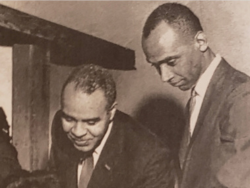
Even before the College of Wooster students organized to start a chapter of the NAACP, they were interested in becoming involved in the ongoing Civil Rights Movement, for example, Herbert Wright, , came to the College of Wooster in 1960. He came to teach students about how they could help with sit–down strikes. Wright served in World War II before attending the University of New Mexico, which led to him starting his own chapter of the NAACP and he served in leadership roles in the national organization.1 When Wright came to Wooster, he made three-point program including: students endorsing the protests put on by college students at Southern Black colleges, raising funds to help bail students out of jail and pay for court fines, and lastly boycotting some national chains. He went on to alert the Wooster students about the response some anti-Black hate groups would have to these actions. He ended by criticizing President Eisenhower for not helping with the rise in racial tensions. Wright’s goal was to visit several other colleges, like the College of Wooster, to help teach students about how they could get involved with the protests going on in the South.2
- Bobby Donaldson, “Herbert Lee Wright (1927-2020): An Architect of Justice.” Facing South, June 4, 2020
- “NAACP Man Tells Wooster Students They Can Help”, Daily Record (Wooster, Ohio), April 14, 1960
Founding 1960
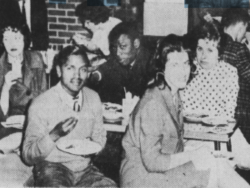
In 1963, the College of Wooster had its first NAACP meeting on campus. During the meeting they elected officers and discussed future plans for the chapter. They welcomed all students interested in joining to come to the weekly meetings.1
- “Students Organize NAACP Chapter”, Wooster Voice, November 8, 1963
Tutoring Sessions 1964
From its start, the Wooster-Orrville NAACP was deeply committed to educational justice. In 1964, the college NAACP established a tutoring program targeting junior high and high school students in Orrville. Originally intended to be held at a Black church, weekly study sessions were held on Saturdays at the Orrville High school.1 Students of any race and background were welcomed at the sessions. The program was a joint effort between college students from Wooster and the NAACP.2 The program’s first semester was deemed a success. Students who attended these events achieved higher grades, and parents commended the school board, for the use of their facilities and materials, and the college students, for their time.3 This motivated the NAACP to continue their efforts and possibly extend their reach. There was discussion of extending the program’s involvement to Wooster if the Wooster school board allowed it.4 The program did, in fact, expand their age range to starting from 5th grade, reaching through 12th grade.5
- “NAACP Has Chapter on Wooster Campus,” Daily Record (Wooster, OH), February 5, 1964, 14.
- Alma Kaufman, “Education Called Aim of Wooster’s NAACP,” Daily Record (Wooster, OH), July 14, 1964, 16.
- “Study Sessions Are Praised,” Daily Record (Wooster, OH), May 22, 1964, 7.
- Kaufman, “Education Called Aim of …,” 16.
- “NAACP Plans More Orrville Study Sessions,” Daily Record (Wooster, OH), October 2, 1964, 19.
Voting Rights 1965
As racial tensions rose in the South in 1965, the College of Wooster NAACP wanted to help those in the South by encouraging others to take action. They did this by encouraging people in Wooster to see racial injustice as a nation, not a regional, issue that even affected Wooster. They urged the community to write to President Lydon B. Johnson, Attorney General Nicholas Katzenbach, and their local congressional representatives to pass bills allowing Black people the right to vote.1
- “Secret Huddle Are Held Regarding New Voting Law”, Daily Record (Wooster, Ohio), March 15, 1965
Organization Goals 1969
In early 1969, temporary officers were elected for the Wooster NAACP chapter. The officers set goals for the organization in Wooster, focusing on memberships, education, and establishing committees to help publicize violations of civil rights. A priority amongst these goals was improving opportunities for young Black people, and the improvement of the housing situation in Wooster. However, the local chapter had yet to be chartered due to not reaching the minimum requirement of 50 paid memberships.1
- “NAACP To Start Drive On Membership” ,Daily Record (Wooster, Ohio), January 27, 1969
James Harris’ Presidency 1969
In 1969, during one of the weekly meetings of the Wooster/Orville NAACP, the members held elections for the new board officers. James Harris was elected as the new president. . Outside of elections, some Orville attendees requested for a NAACP youth group, to which a committee was formed under the supervision of president elect James Harris. The organization continued with their mission to put black history books in local public schools.1
- “James Harris As President”, Daily Record (Wooster, Ohio), July 28, 1969
