
In the 1970s, the NAACP had an emphasis on economic justices. It advocacated for economic opportunity for minorities in the Wooster community through workshops and calls for investigations of local employers1. In addition to their work for economic opportunities, the organization called for local schools to celebrate Martin Luther King Jr.
- “Affirmative Action is a Workshop Topic”, Daily Record (Wooster, Ohio), December 6, 1978
- “Insist on King Day”, Daily Record (Wooster, Ohio), February 21, 1978
Key Events of the 1970s
 Black Business Discussion 1970
  Welfare Dinner 1970
  Addressing Housing Issues 1971
  Dedication to Equal Opportunity 1978
  MLK Day 1978
Rubbermaid Investigation 1978
MLK Day 1978
Rubbermaid Investigation 1978  Freedom Fund Banquet 1978
  Addressing School Issues 1978
  Affirmative Action Workshop 1978
  Dr. Mayo Speaks 1979
 Black Business Discussion 1970
- “Group To Discuss Black Businesses”, Daily Record (Wooster, Ohio), February 6, 1970
Welfare Dinner 1970
In 1970, the NAACP took part in a dinner focused on welfare rights planned by the Wayne County Interfaith Commission on Human Rights. The theme of the dinner was “Welfare in Wayne County – Does Welfare Provide for the Poor?” This dinner event was a collaboration between many groups including the Human Rights Commission, AAUW Human Rights Committee, County Church Cabinet, Church Women United, League of Women Voters Human Recourses Committee, the College of Wooster’s sociology department, the Mayor’s Citizen Advisory Committee, B’nai B’rith, and St. Mary’s Community Action Commission. 1
- “Interfaith Commission Plans Meeting Dinner Meeting on Welfare”, Daily Record (Wooster, Ohio), April 7, 1970
Addressing Housing Issues 1971
In 1971, a representative from the NAACP was among the speakers at a meeting which aimed to address discrimination and housing issues in Wooster. The meeting was held by Wayne County Interfaith Commission and the Community Action Commission. The meeting had several speakers who discussed housing discrimination against Black people in Wooster, rent supplements and possibilities for new housing in urban areas, and integrated housing. The other speakers included, a professor from the College of Wooster, the chairman of the Commission on Human Resource, the chairman of St. Mary’s, and the chairman for the meeting. This meeting was part of a broader push in the NAACP during the 1970s to address racialized housing discrimination in Wooster. 1
- “Housing To Be Meeting Topic For Interfaith”, Daily Record (Wooster, Ohio), January 29, 1971
Dedication to Equal Opportunity 1978
In 1978, there was an issue with equal opportunity in Wooster that caused several meetings to be held. With members of the Wooster City Council missing from the Council meeting, an informal resolution was adopted unanimously to renew dedication to equal opportunity for all citizens in Wooster. The resolution also recognized the observance of Martin Luther King Jr. Day in the town. James Harris, president of the Wooster-Orrville NAACP, talked about his appreciation for the resolution by acknowledging the difficulties small cities face when trying to get equal opportunity due to the citizen’s lack of awareness.1
- “Housing To Be Meeting Topic For Interfaith”, Daily Record (Wooster, Ohio), January 29, 1971
MLK Day 1978
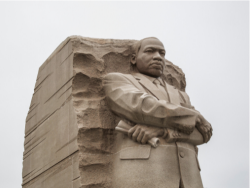
In 1978, during a Wooster City school board meeting, several people voiced their concern for Martin Luther King Jr. Day to be recognized in the 1978-1979 school board calendar. One of the people who raised their voice was the president of the Wooster-Orrville NAACP, James Harris. Harris argued that Martin Luther King Jr. Day is more than a day and that the school board’s decision could trigger protests. He also called for Martin Luther King Jr.’s accomplishments to be recognized as something all people, not just Black people, should want to honor. Lydia Thompson, a member of the school board, acknowledged the importance of adding the day to the school board calendar, however she stated that she would support any decision made by the school board. 1
- “Insist on King Day”, Daily Record (Wooster, Ohio), February 21, 1978
Rubbermaid Investigation 1978
In 1978, the Wooster-Orrville NAACP asked the U.S. Department of Justice to investigate the Rubbermaid Inc. of Wooster and their employment practices. The NAACP chapter charged the company with a violation Title VII of the Civil Rights Act of 1964, which employment discrimination based on race, color, religion, sex and national origin. Specifically, it charged that Rubbermaid had violated the act in regards to hiring, discharge, benefits, and wages. Rubbermaid released a statement expressing their confusion as the president of the Wooster-Orrville of the NAACP was an employee at the location accused of discrimination. The Equal Opportunity Commission was also involved with the investigation of the company. The call for the investigation into Rubbermaid was part of the organization’s broader push for equal employment opportunities in Wooster and the surrounding areas. 1
- “Rubbermaid is Accused of Employment Violation”, Daily Record (Wooster, Ohio), April 19, 1978
Freedom Fund Banquet 1978
In 1978, the Wooster-Orrville NAACP started their continuing participation in a national NAACP tradition of hosting an annual Freedom Fund Banquet.1 The Freedom Fund Banquet is a dinner that serves as a fundraiser for the local chapter to support its efforts. It also serves as an opportunity for a local chapter to reflect on their achievements.2 One of the key features of the event is a keynote address. The address usually has a message connected to the pursuit of freedom or the advancement of civil rights. This speech is often given by movers and shakers in civil rights, which has included state and national level members of the NAACP, civil rights activists, elected officials, and local community members.3 One of the most notable speakers the Wooster-Orrville NAACP has hosted for this event is Rosa Parks in 1989.4 This was the most heavily attended Freedom Fund Banquet to date because having the iconic “mother of the civil rights movement” take the time to interact with Wayne County truly meant a lot to many citizens.5
Though this event is a national tradition, the Wooster-Orrville NAACP formed aspects that make it unique to their group. Along with standard awards, they created a special namesake humanitarian award, which honors longtime citizen and member, Lydia Thompson, and her extraordinary activist efforts.6 They also adopted a distinct focus on providing college scholarships to high school students through this event. This annual banquet has become one of the most significant yearly events for the Wooster-Orrville NAACP.7
- Barb Brucker, “‘Freedom Fund’ Banquet for Local NAACP,” Daily Record (Wooster, OH), September 18, 1978, 30.
- “Freedom Fund Dinner,” NAACP Cleveland Branch, n.d., https://clevelandnaacp.org/freedom-fund-dinner/.
- Barb Brucker, “‘Still Fighting For Freedom’ Says NAACP Official,” Daily Record (Wooster, OH), September 22, 1979, 9.
- E. E. Johnson, “Mother of Civil Rights Movement Will Speak at Local NAACP Event ,” Daily Record (Wooster, OH), May 11, 1989, 1.
- Theoharis, Jeanne, Woodard, Komozi, and Gore, Dayo F., eds. Want to Start a Revolution? Radical Women in the Black Freedom Struggle. New York: New York University Press, 2009. Chapter 5.
- Mark Spigos, “NAACP Freedom Fund Dinner on Oct. 11 Raise Money for Local Grads,” Daily Record (Wooster, OH), September 26, 2014.
- Chanda Neely, “Local NAACP Fund-Raiser Is Saturday,” Daily Record (Wooster, OH), October 24, 2006.
Addressing School Issues 1978
In 1978, members of the Human Rights Group of the Wooster Branch of the AAWU were addressed by Sylvia Lockett to raise awareness about some issues, such as harassment of minority students, in Wooster. Sylvia Lockett is a resident of Wooster, known in the community for participating in church and choir events in the city.1 Wooster-Orrville NAACP president James Harris also addressed the people of the meeting by talking about the need for recognizing Black Wooster students by merit rather than skin color. He also urged for more Black teachers in lower grades and physical education to be added to Wooster City schools. Lockett emphasized that two of the twenty-eight teachers recently hired were minorities. She finished by talking about ways to improve the attitudes of both Black students and parents by exposing them to more opportunities after they graduate school. 2
- “Wooster Music Group To Start”, Daily Record (Wooster, Ohio), January 15, 1969
- “Sylvia Lockett Speaks About Minority Students”, Daily Record (Wooster, Ohio), November 15, 1978
Affirmative Action Workshop 1978
In 1978, the NAACP cosponsored a workshop in Wooster focused on Affirmative Action concerning women and minorities. The workshop was free for all who wanted to attend. The workshop followed the publication of a report from the Task Force of Social and Economic Justice that called for more employment opportunities for women and minorities in the Wooster City administration. The workshop was led by John Gray, a former employee of a large corporation, and cosponsored by many other local organizations including Wayne County Health, Education and Welfare, League of Women Voters, People’s Federal Savings and Loan Association, Citizens National Bank, Wayne County National Bank, and Wayne County Savings and Loan. 1
- “Affirmative Action is a Workshop Topic”, Daily Record (Wooster, Ohio), December 6, 1978
Dr. Mayo Speaks 1979
In 1979, Rev. Dr. J. Haskell Mayo of Chicago came to Wooster to help educate people in the community by speaking to them about “The Perils of Black Progress”. Dr. Mayo was known for his work with various protests and movements, including the Detroit March of Two Hundred Thousand. He has also been involved with the building of several AME churches in Washington D.C. and in St. Louis. The event was put on with the help of the Wooster-Orville NAACP, the College of Wooster’s Black Student Association, and Harambee House. Part of the College of Wooster campus community helped the NAACP with ticket sales, helping bring Black students to community events.1
- Judi Miller, “Blacks Don’t Want Handouts”, Daily Record (Wooster, Ohio), May 26, 1979